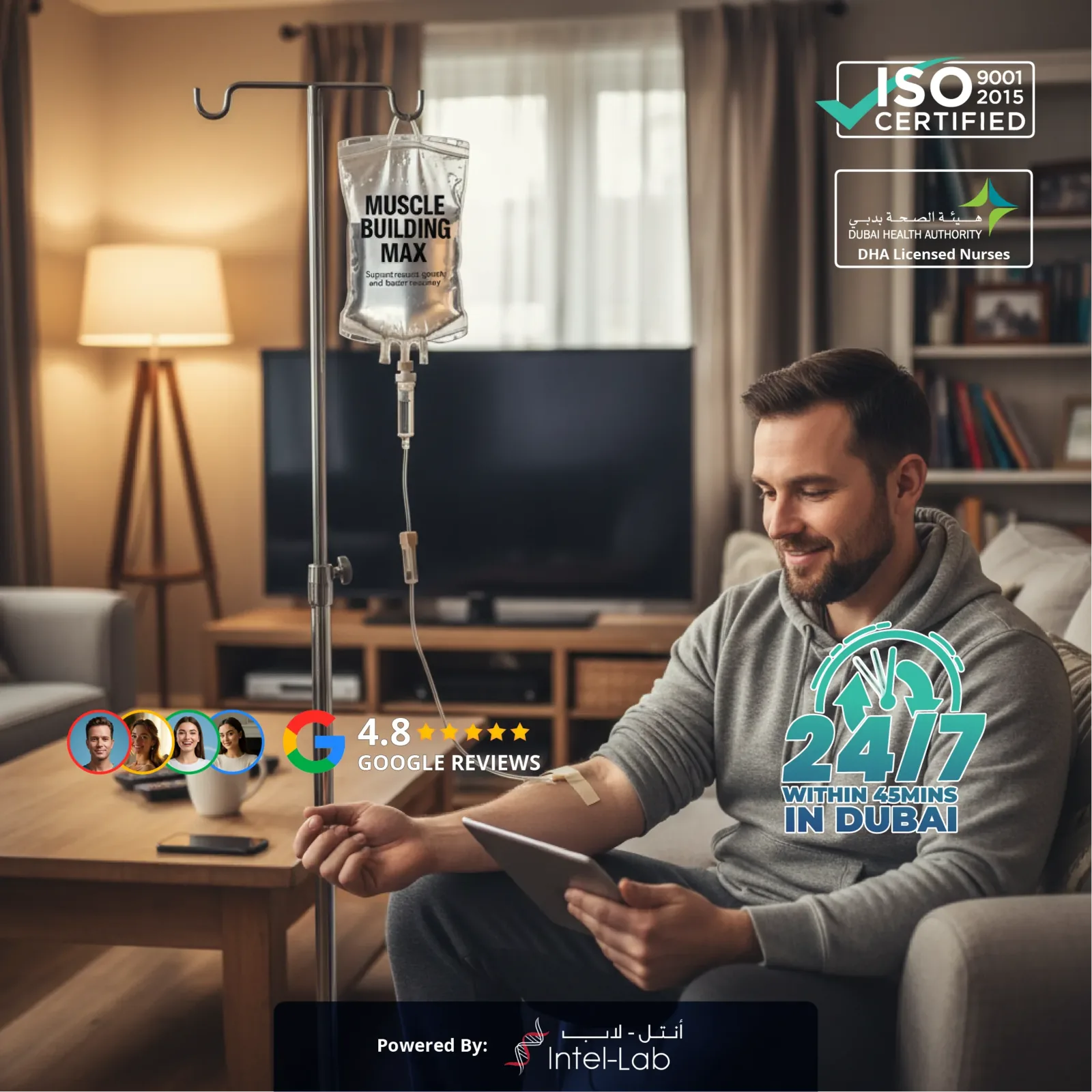
Anti-stress & Antioxidant IV Drip · at home in Dubai
This therapeutic infusion combines stress-reducing nutrients with potent antioxidants to help combat the effects of daily stress, restore balance, and promote overall well-being.

Physician assessment, the drip & ICU-trained nurse at your door — no clinic visit.
Book a home visit- Prescribed by a DHA-licensed physician
- Administered by an ICU-trained nurse
- At home, your hotel or gym in Dubai
- Available 24/7 · 365 days
Every active, and what it does for you
Select an active to see what it is and why it's in your formula.
An active compound in the Anti-stress & Antioxidant, delivered intravenously for full-potency absorption.
Explore IV therapy →Part of your prescribed IV formula.
An active compound in the Anti-stress & Antioxidant, delivered intravenously for full-potency absorption.
Explore IV therapy →Part of your prescribed IV formula.
An active compound in the Anti-stress & Antioxidant, delivered intravenously for full-potency absorption.
Explore IV therapy →Part of your prescribed IV formula.
An active compound in the Anti-stress & Antioxidant, delivered intravenously for full-potency absorption.
Explore IV therapy →Part of your prescribed IV formula.
An active compound in the Anti-stress & Antioxidant, delivered intravenously for full-potency absorption.
Explore IV therapy →Part of your prescribed IV formula.
An active compound in the Anti-stress & Antioxidant, delivered intravenously for full-potency absorption.
Explore IV therapy →Part of your prescribed IV formula.
An active compound in the Anti-stress & Antioxidant, delivered intravenously for full-potency absorption.
Explore IV therapy →Part of your prescribed IV formula.
An active compound in the Anti-stress & Antioxidant, delivered intravenously for full-potency absorption.
Explore IV therapy →Part of your prescribed IV formula.
An active compound in the Anti-stress & Antioxidant, delivered intravenously for full-potency absorption.
Explore IV therapy →Part of your prescribed IV formula.
An active compound in the Anti-stress & Antioxidant, delivered intravenously for full-potency absorption.
Explore IV therapy →Part of your prescribed IV formula.
An active compound in the Anti-stress & Antioxidant, delivered intravenously for full-potency absorption.
Explore IV therapy →Part of your prescribed IV formula.
Feel the difference — without leaving home
The formula is delivered directly into the bloodstream, bypassing the digestive bottleneck so every compound is available at full potency. A DHA-licensed physician prescribes it after a quick assessment and an ICU-trained nurse administers it at your home, hotel or gym in a single session.
Who it's for
- calm
- recovery
How it works
- 1Contact usCall or WhatsApp 24/7 — our clinical team takes your details and books a slot.
- 2Physician assessmentA DHA-licensed doctor reviews your goals and prescribes the formula.
- 3Home IV administrationAn ICU-trained nurse sets up the drip wherever you are.
- 4Relax & recoverThe formula absorbs directly into your bloodstream at full potency.
What to expect
From the cannula to feeling yourself again — here's how the session goes.
Getting started
After a quick physician assessment, your nurse checks your vitals and places a fine cannula — it feels like a standard injection.
During the drip
You relax while the formula infuses directly into your bloodstream at full potency.
Afterwards
The cannula comes out and you carry on with your day — no downtime.
How often
Your nurse advises on frequency based on your goals and how you respond.
Ready when you are — book your Anti-stress & Antioxidant
Pick a time or start below — choose IV Infusion Therapy and a DHA-licensed nurse will be at your door, usually within 45 minutes.
How to prepare
No fasting is needed. Eat beforehand and drink water through the day; the session is more comfortable when you are not dehydrated. Wear sleeves that roll up easily. The magnesium component is infused slowly on purpose — given quickly it causes a warm flush and can leave you light-headed when you stand, so allow the full session and get up slowly afterwards.
Who this drip is for
For people under sustained pressure — long working weeks, disturbed sleep, or a stretch where recovery has not kept pace with demand. Healthy adults. Magnesium infusions are not suitable in significant kidney disease, and our doctor reviews your history first. This supports the physical side of stress; persistent low mood, anxiety or insomnia deserve a proper consultation rather than an infusion.
Everything you need to know about the Anti-stress & Antioxidant
This therapeutic infusion combines stress-reducing nutrients with potent antioxidants to help combat the effects of daily stress, restore balance, and promote overall well-being.
Stress is not only a feeling. It is a chemical process, and it spends specific nutrients at a measurable rate for as long as the pressure lasts. That is why a quiet weekend can leave you rested and still not recovered: rest stops the spending, but it does not replace what has already been spent.
What sustained pressure does to your body's chemistry
The hypothalamic-pituitary-adrenal axis is the loop that converts a demand into cortisol. Over an afternoon it is doing exactly what it evolved to do. Over months it runs at a cost. Cortisol synthesis draws on vitamin C, which the adrenal cortex holds at a higher concentration than almost any other tissue, and on several B vitamins sitting in the same pathway. Magnesium is lost through the kidneys faster when cortisol stays raised, and zinc is redirected away from other functions.
None of this presents as a symptom you can point at. It presents as a slow reduction in how well you tolerate the next demand — the same workload, less capacity for it.
Why magnesium and vitamin B6 do most of the calming work
Magnesium sits on the inhibitory side of the nervous system. It supports GABA signalling and dampens the excitatory glutamate receptor that keeps a stressed brain switched on. Low magnesium makes the stress axis more reactive rather than less, so the deficiency reinforces the state that produced it.
Vitamin B6 is the cofactor that completes the synthesis of serotonin, dopamine and GABA from their precursors. Under prolonged stress the body diverts tryptophan down the kynurenine pathway instead, producing stress metabolites rather than serotonin. Restoring B6 supports the enzymes that push that chemistry back the other way.
The oxidative load you never feel directly
Producing stress hormones is metabolically expensive, and expensive metabolism generates free radicals. At the same time the systems meant to neutralise them are being drawn down: glutathione is consumed, riboflavin is required to regenerate it into its active form, and zinc forms part of one of the body's principal antioxidant enzymes.
Antioxidant capacity therefore falls at exactly the point where demand for it rises. That is why the calming nutrients and the antioxidant ones share a single infusion. Physiologically they are two halves of one problem rather than two separate goals.
The gut-brain link that stress advice usually skips
Sustained cortisol increases the permeability of the intestinal lining. When that barrier loosens, bacterial fragments reach the circulation in small quantities and provoke a low-grade inflammatory response — felt as flat mood, poor concentration and a body that aches without an obvious reason.
Glutamine is the primary fuel for the cells lining the intestine, so supplying it supports the barrier that the stress response has been quietly eroding. It is a slower and less obvious benefit than simply feeling calmer, and often a more durable one.
Who tends to book this one
People whose stress has stopped being purely psychological: sleep that does not restore, mental fatigue that outlasts the weekend, a shorter fuse than usual, unsettled digestion, low mood that rest is not lifting. Long working hours, relocation, caring for a family member and a run of high-stakes deadlines all produce the same picture.
It is a recovery infusion rather than a treatment for a diagnosed psychiatric condition. A doctor reviews your history and your regular medication before the first session, and pregnancy or breastfeeding changes what is appropriate. The nurse comes to your home, hotel or office, so the session costs you nothing beyond the time it takes.
Compare with other Max drips


Care you can trust — from named, DHA-licensed clinicians

Written for Vesta Care patients in Dubai, using the laboratory's own panel definitions and reference ranges. Content is reviewed for clinical accuracy before publication and updated whenever the panel composition changes.

Independently reviewed for clinical accuracy: the biomarkers listed, what each one measures, the conditions it helps identify and the preparation advice were checked against current laboratory practice. Reviewing clinician is always different from the author, and no page is published without this second read.
The right drip, matched to how you feel
Every Vesta Care drip is physician-prescribed and delivered to your door. Tell us your goal and see exactly what it delivers — then book in a tap.